SQ Flat Wire Common Mode Choke Inductor Overview
The SQ Flat Wire Common Mode Choke Inductor is designed to address a common problem in modern electronics: unwanted common-mode noise that travels along power or signal lines and interferes with circuit performance. In compact boards, switching power supplies, adapters, industrial controllers, and communication systems, this interference can lead to unstable operation, EMI compliance challenges, and reduced signal quality. A common mode choke provides a practical way to suppress that noise while allowing the useful current to continue through the circuit path.
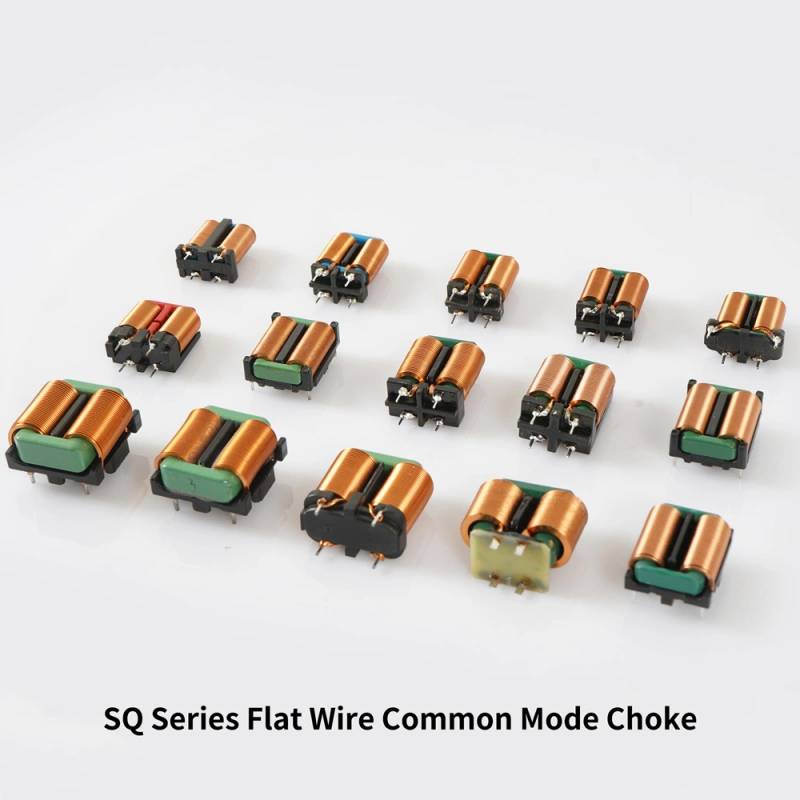
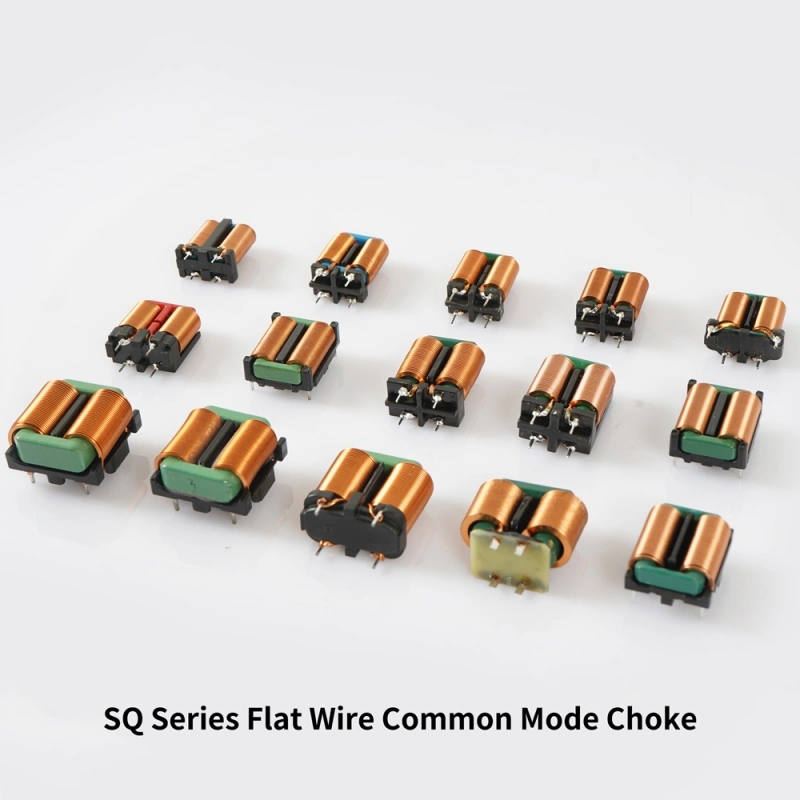
From the visible construction, the SQ Series Flat Wire Common Mode Choke uses two copper-colored flat-wire windings arranged in a symmetrical layout on a compact magnetic core assembly. The part is built for PCB mounting with through-hole pins, making it suitable for designs that need secure mechanical attachment and reliable electrical connection. The series format suggests multiple size or configuration options within the same product family, which is useful for engineers comparing board space, current path design, and filtering needs.
What This Component Does
A common mode choke is an EMI suppression component that helps block noise currents that appear in the same direction on both conductors. In practical terms, it targets interference rather than the intended power or signal flow. This makes it especially relevant in circuits where differential current should pass with minimal disruption, but common-mode noise needs attenuation before it reaches other sections of the system or radiates from the cable or board.
For buyers, the main value is not simply “adding an inductor.” It is improving system robustness. Better noise control can support cleaner operation, reduce the chance of false triggering in control electronics, and help designers manage electromagnetic compatibility at the board level.
Product Structure and Visible Design Features
Flat-wire winding construction
The most noticeable feature is the flat-wire coil structure. Flat wire is often selected in magnetic components because it can support compact winding geometry and a neat winding profile. In the visible product, the windings appear tightly formed and evenly placed, which is consistent with a component intended for repeatable PCB assembly.
Dual-winding common mode layout
The two windings are arranged symmetrically, which is characteristic of a common mode choke. This geometry helps the component present high impedance to noise currents that are common to both lines, while maintaining the desired path for normal circuit current. The symmetry is also useful from a manufacturing and quality-control standpoint because matched winding geometry supports consistency across a product family.
Through-hole PCB terminals
The visible pin terminals indicate through-hole mounting. This format is often preferred where the component may experience vibration, thermal cycling, or handling stress during assembly. It also gives designers a stable mounting option when compared with some surface-mount alternatives, especially in power electronics and industrial hardware.
Key Capabilities Buyers Typically Look For
Because exact electrical ratings were not provided, it is best to evaluate this SQ Flat Wire Common Mode Choke Inductor as a hardware platform rather than assume a specific inductance or current value. In buyer evaluation, the main capability areas usually include:
Noise suppression performance for common-mode EMI
Mechanical fit on the PCB footprint
Current path compatibility with the target circuit
Thermal behavior under operating load
Assembly stability in automated or manual soldering processes
For engineering teams, the key question is whether the part can be matched to the line conditions of the end product. That includes power supply topology, switching frequency environment, cable length, and the type of noise that must be reduced.
Materials and Finish Options
Based on the visible construction, the windings appear to be copper or a copper-alloy flat wire. The magnetic core material cannot be confirmed from the image, although ferrite or a similar magnetic material is a common choice in this kind of EMI suppression component. The base/frame is black molded material, and some versions show green end pieces or spacers. These visible differences may reflect product variants within the same series.
Exact surface finish, insulation system, and core composition are not identifiable from the image alone, so buyers should confirm those points directly when selecting a part for a regulated design, elevated temperature environment, or long-life industrial application.
Manufacturing Process and Build Considerations
Flat-wire common mode chokes are typically made through a combination of precision winding, core assembly, lead formation, and encapsulation or frame mounting. In a component like this, the winding process must keep the two coils closely matched so that the common-mode rejection behavior remains stable from unit to unit. The visible product also suggests careful mechanical assembly, since the windings, core, and base are integrated into a compact body suitable for board insertion.
For manufacturers and purchasing teams, consistency in winding geometry is important. If a choke is used in a power supply or communication board, even small variations in assembly can affect how the component behaves under noise conditions. That is why the repeatable structure of a series product is often a major buying consideration.
Typical Application Scenarios
This SQ Flat Wire Common Mode Choke Inductor is relevant wherever EMI suppression is needed on power or signal lines. Common application scenarios include:
Switching power supplies and AC-DC adapters
DC-DC converters and embedded power boards
Industrial control systems and automation electronics
Communications equipment and network-related hardware
Consumer and office electronic devices that require noise filtering
In these environments, the choke is usually placed at the input or along a sensitive line to reduce the amount of conducted noise that reaches the rest of the circuit or leaves the system through connected cables.
Quality Control and Selection Checks
Since no test data or certification details were provided, buyers should focus on general selection checks that are standard for EMI components. These include verifying the footprint, checking lead spacing, reviewing mechanical height clearance, and confirming that the electrical characteristics fit the intended line conditions.
For a PCB-mount common mode choke, practical quality-control points often include winding symmetry, lead integrity, visible insulation condition, secure core assembly, and consistency across samples. When used in production, incoming inspection may also look at solderability and dimensional repeatability so the part can be mounted reliably in automated assembly.
Customization Guidance for OEM and PCB Designers
If your project requires a specific current rating, footprint, mounting style, or EMI target, customization may be worth discussing. For this type of component, common customization topics include core size, winding specification, pin layout, overall height, and package style. Buyers should also confirm whether the component must match an existing board outline or fit into a limited enclosure height.
Before requesting a custom version, prepare the basic electrical and mechanical requirements: line voltage type, operating current, target frequency range, board space, thermal limits, and the kind of interference you are trying to suppress. That information helps the supplier recommend a practical common mode choke structure rather than a generic substitute.
How to Evaluate the Right Variant
Choosing the right SQ Flat Wire Common Mode Choke Inductor is usually a matter of matching the component to the application rather than selecting the largest or most complex version. Buyers should compare the available series variants against these factors:
Board space and mounting clearance
Expected current flow through the line
Noise type and severity
Need for through-hole robustness
Compatibility with the rest of the EMI filter network
If the component is part of a broader input filter, coordination with capacitors, layout routing, and grounding strategy will matter as much as the choke itself. EMI performance depends on the full circuit, not a single part in isolation.
Why Flat Wire Can Be Relevant in EMI Suppression
Flat wire is often favored in compact magnetic components because it can support an orderly winding profile and efficient use of space. In a common mode choke, that can be helpful when the design needs a balanced winding structure with practical assembly dimensions. The visible flat-wire form in this series also gives the component a distinct construction style compared with round-wire alternatives.
For buyers, the important point is not the appearance alone. It is whether the form factor contributes to the needed electrical and mechanical behavior for the target circuit. In many power and signal applications, a well-built flat-wire choke can be a useful option when board layout and EMI requirements are both tight.
Requesting the Right Part
If you are sourcing the SQ Flat Wire Common Mode Choke Inductor for a new design or replacement project, ask for the full electrical specification, mechanical drawing, and recommended application range before committing to production. That will help you avoid mismatch in inductance, current handling, or footprint.
For OEM, EMS, and electronics buyers, the best next step is to compare your circuit requirements with the available series version and confirm the exact variant that fits your board and EMI goals. If you need help selecting a common mode choke for a power supply, control board, or communication device, send your operating conditions and layout constraints to start the specification review.