Embedded Ultra-thin Flat Transformer Overview
An Embedded Ultra-thin Flat Transformer is used when a designer needs compact power conversion without giving up board space. In embedded electronics, the common problem is not only stepping or regulating voltage, but doing it inside a tight enclosure where height, layout, and electrical isolation all matter. This type of PCB-mounted magnetic power module is suited to that challenge because it integrates transformer-based power handling into a low-profile assembly that can sit directly on the board.
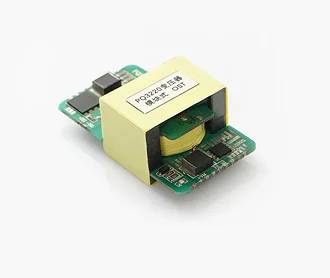
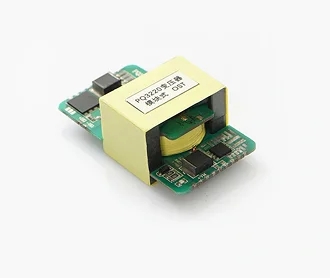
From the visible construction, the module appears to combine a green PCB, surface-mount control components, and a wound magnetic element with insulating tape and a protective cover. That structure points to a compact power module intended for embedded systems, industrial controls, communication equipment, instrumentation, or other low-voltage devices that need local conversion close to the load.
Product Structure and What It Solves
For many OEM and electronics engineering teams, the main issue is fitting a stable power stage into a small product housing. A traditional power supply can be too tall, too bulky, or too difficult to route through the internal PCB layout. An Embedded Ultra-thin Flat Transformer helps solve this by combining magnetics and power electronics in a compact form factor that supports board-level integration.
The visible design suggests a module built for efficient use of volume. The transformer or inductor is positioned directly on the PCB, with nearby semiconductor components handling switching or rectification functions. Because the magnetic element is integrated into the assembly, the result is easier to place during system design than a separate transformer plus discrete support circuit.
Visible Construction and Key Features
PCB-mounted design
The product is built on a rectangular printed circuit board, which makes it suitable for direct mounting into an embedded product line. This format simplifies mechanical integration and helps designers keep power conversion close to the point of use.
Magnetic component with insulation
A large ferrite-based magnetic part is visible, wrapped with yellow insulating tape and surrounded by a beige or yellow protective cover. That kind of construction is typically used to support winding protection, electrical separation, and mechanical stability in transformer-related assemblies.
Surface-mount electronic components
Several black SMD parts are visible on the board. These may include a controller IC, rectifier devices, or passive support components. While the exact circuit function cannot be confirmed from the image alone, the layout indicates an integrated power conversion module rather than a simple passive transformer.
Compact and open-framed form
The module has a compact footprint and an open-framed side, with PCB edges visible and no full external enclosure. This is often useful in applications where the final product already provides housing or where height reduction is a priority.
Specifications and Capabilities to Evaluate
Because the visible label text is not readable and exact electrical data cannot be confirmed, buyers should treat this as a structural product reference rather than a finalized rating sheet. For procurement and engineering review, the key specifications to verify are the following:
- Input voltage range
- Output voltage or multiple outputs
- Power rating
- Isolation requirement, if applicable
- Operating temperature range
- Board height and overall dimensions
- Pin layout and mounting method
- Noise and ripple limits
- Protection features such as short-circuit or overload handling
In embedded systems, the right choice is usually not just about power level. A buyer also has to confirm thermal behavior, mechanical fit, isolation needs, and compatibility with the final PCB assembly process.
Materials and Finish Options
The visible assembly uses a standard green PCB, which is common in industrial and commercial electronics. The copper layers and solder mask are not visible in detail, but the module clearly relies on standard PCB construction with soldered SMD parts and magnetic assembly hardware.
For this kind of product, material and finish options may include different board thicknesses, solder mask colors, pad finishes, and magnetic insulation methods depending on the application. The magnetics can also be adjusted in winding arrangement, core material selection, and encapsulation approach to match the thermal and electrical demands of the target system.
If the module is being customized for a specific design, the finish of the board and the protective treatment around the magnetic component can matter as much as the electrical spec. That is especially true in vibration-prone equipment or compact enclosures with limited airflow.
Manufacturing Process
This product type typically involves a combination of SMT assembly and magnetic-component processing. Based on the visible structure, the manufacturing flow likely includes PCB fabrication, stencil printing, SMT placement, reflow soldering, and then assembly of the wound magnetic element. In some designs, through-hole parts or manual steps may be added for components that carry higher current or require stronger mechanical retention.
The magnetic section may require winding, insulation layering, tape wrapping, and inspection before or after board integration. Because transformer-based modules carry both electrical and thermal load, process control during assembly is important. Placement accuracy, solder quality, insulation integrity, and final electrical testing all affect reliability.
Typical Application Scenarios
An Embedded Ultra-thin Flat Transformer is typically chosen for equipment where space is restricted and power must be delivered locally on the main board. Common use cases include:
- Industrial control modules
- Communication equipment
- Embedded controllers and automation boards
- Instrumentation and measurement devices
- Adapters and compact power modules
- Low-voltage subassemblies in custom electronics
In these systems, the module can help reduce external wiring, simplify the bill of materials, and keep the power stage close to sensitive downstream circuits. That proximity is often valuable when voltage stability and board layout efficiency are both priorities.
Quality Control Considerations
For buyer evaluation, quality control should focus on both the electronic and mechanical sides of the assembly. Since the exact electrical performance is not visible from the image, it is better to ask for documented test criteria rather than assume ratings.
Useful checks include solder joint inspection, transformer winding consistency, insulation placement, polarity verification, and functional power testing. If the module is intended for isolation, dielectric and separation requirements should be confirmed in the engineering drawing or test report. Thermal rise under load is another important point, especially when the module will be enclosed in a small housing.
Buyers should also request dimensional confirmation. In compact electronics, a few millimeters can determine whether the module fits under a cover, beside a connector, or within a shielded compartment.
Customization Guidance for OEM Projects
For custom electronics programs, the most useful customization usually begins with the power target. Once the input source, output requirement, and isolation need are defined, the transformer structure and support circuit can be adjusted accordingly. This may involve changing winding turns, board layout, component selection, mounting orientation, or connector style.
Customization may also include adapting the thermal design for higher ambient temperatures, revising the board outline to fit a host product, or changing the protection strategy for demanding environments. If the module will be produced in volume, it is worth aligning the design early with the final assembly process so that component placement and inspection are both repeatable.
When asking for a custom version, provide the expected input range, load profile, peak current, operating environment, and mechanical envelope. Those details help the manufacturer choose an appropriate magnetic structure and board architecture without overengineering the module.
Buyer Decision Factors
Before selecting this type of power module, buyers should compare several practical points rather than looking only at size. First, check whether the product matches the electrical topology required by the system, such as isolated conversion or non-isolated regulation. Second, confirm that the footprint and height work with the final enclosure. Third, verify that the module can handle the expected thermal load under real operating conditions.
It is also worth reviewing the component sourcing strategy and assembly consistency, especially for OEM programs that need stable long-term supply. If the product will be integrated into a regulated device, documentation and test support become important purchasing factors as well.
Requesting the Right Version
Because the image alone does not reveal exact voltage, power rating, or isolation details, the safest next step is to share your target application and electrical requirements. A suitable version of the Embedded Ultra-thin Flat Transformer can then be matched to your board space, load profile, and product environment.
If you are developing an industrial controller, compact adapter, communication device, or embedded module, this category of transformer-based board assembly can be a practical route to stable power in a thin package. Send your input/output targets, dimensional limits, and application notes to start the review process.
Contact for Specification Review
For OEM sourcing, custom design support, or drawing-based evaluation, please provide your required electrical parameters and mechanical constraints. A clear specification package will help determine whether this Embedded Ultra-thin Flat Transformer is a fit for your project and what changes may be needed for production.